Search This Blog

Showing posts with label sculpture. Show all posts

Sunday, 13 November 2011

Grayson Perry, The Tomb of the Unknown Craftsman, British Museum

Grayson Perry (or should I say Claire) is an artist, a big character and now a celebrity; he has always intrigued me. When I worked at England & co gallery, I helped organise an exhibition of his work from his time as a Neo-Naturist, an eccentric group of artists who assembled in the late 70s. Meeting him, as Claire, at the private view was exciting but less over-the-top than I imagined... he was just an ordinary albeit very talented guy with an unusual alter ego.

Interestingly, his current show at the British Museum, The Tomb of the Unknown Craftsman, shows the more discreet, human side of Grayson's character. A very personal and insightful collection of works old and new, he has selected pieces from the British Museum’s collection that illustrate or echo his beliefs and artistic obsessions and has created his own works to be displayed alongside the artefacts.

The ceramics dominate and for me have always been his most impressive work - giant colourful vases and primitive but highly decorative plates. His amazing imaginary world is explored better here than ever before. The exhibition begins and ends with epic 'sculptures', on entering we witness the 'Kenilworth AM1' motorcycle, a psychedelic vehicle created as a mobile homage for his beloved teddy, Alan Measles. As a conclusion Perry exhibits a huge cast iron boat with relics hanging meaningfully all over.

The most wonderful thing about this collection is hearing Grayson Perry's thoughts and memories. Many of his quotes are witty, insightful and resonate deeply - he speaks frankly and genuinely, leading us systematically through his work and the decisions he made curating the show.

As a lovely afterthought, we whizzed round the exhibition of German Romantic prints and drawings - a collection of subtle, beautifully detailed works, a quiet contrast to Grayson Perry's world.

Grayson Perry's show continues until 19 February 2012, more info and booking here.

Saturday, 5 November 2011

Degas and the Ballet: Picturing Movement, Royal Academy of Arts

Dance was Degas’ obsession, throughout his life he examined and depicted figures with a hunger to show movement accurately and beautifully. He had no need to make money, his family were wealthy enough to support his vocation, and looking around the Royal Academy’s tribute to the artist, I wondered whether Degas ever intended these works to be displayed at all. Without the need and struggle to earn a living, Degas created art for his own enjoyment, his desire to realistically demonstrate figures in motion was a personal challenge.

The ‘Picturing Movement’ exhibition at the Royal Academy documents all aspects of the artist’s obsession through not only paintings and drawings but also photography and the influence this innovation had on his work is well covered. The earlier paintings were the most recognisable to me - demure scenes from the ballet rendered with a subdued palette. Though Degas shows examples of movement here, it is often calculated and carefully measured; sometimes the models were required to hold tricky en pointe poses for hours so Degas could capture ‘a single moment’.

His later work demonstrates an urgency - paintings that are busier, blurred and colourful; the looser brushstrokes show greater freedom and expression. A room is dedicated to the paintings of Russian dancers, an obvious preoccupation for him at the end of the 19th Century. They are wonderfully dramatic but show less of the romanticism of the earlier pictures, instead there is a sensuality which draws the viewer in. Whereas in the earlier paintings we are voyeurs at a private rehearsal watching the shy ballerinas, here the show is blasé, in your face, they want us to watch them performing and dancing.

My favourite aspect of this show is the lovely sculpture, of which ‘Little Dancer, aged fourteen’ is of course the most famous, the largest and most exquisite, made in painted bronze and adorned with delicate muslin and silk. It is also the only sculpture exhibited in Degas’ lifetime. It is spectacular to see such fragile ballerinas moving with fluidity and yet cast in the toughest most solid bronze, it is a curious juxtaposition of movement and material.

Degas’ work has a timeless beauty and dignity and this exhibition presents this, I would happily go again and again, to wander round in a dream.

Degas exhibition continues until 11 December, book here.

Friday, 5 August 2011

Saatchi Gallery - The Shape of Things to Come


The Saatchi Gallery is a flattering space to show any kind of art, the enormous white rooms can make anything seem spectacular and important. ‘The Shape of Things to Come’ shows a group of bold works from twenty sculptors from around the world.


Of course with many of Charles Saatchi’s exhibitions, one expects to not ‘get it,' after all he is always ahead of the rest of us, sussing out what will be hot before anyone else has had time to move on from the last artistic revelation. This show is slightly different though as it exhibits some older works too; they must hold some significance for Saatchi if they have remained in his favour for this long.


I went along to the Gallery for a work “do," a summer cocktail party in this lush setting. Curators were on hand to explain and discuss the works on display but none of the suited and booted men seemed interested, so I went round for a private guided tour. The lovely Saatchi curator was knowledgeable and spoke at length about the origin and inspiration behind each of the sculptures, answering my questions patiently.


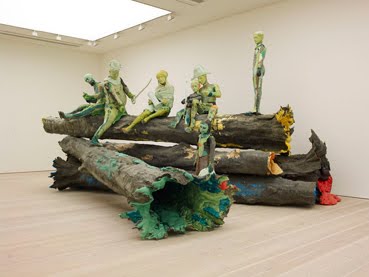
In my opinion, often the artists' intentions are more illuminating than the actual pieces which are in the true sense of the word, ugly. This is particularly the case with the giant work by Folkert de Jong: grotesque green female figures huddling together, a strange seemingly Shrek-inspired work, part of a series called ‘The Shooting Lesson’. Other works too seem obsessed with physicality, desperate to make their presence felt. I was drawn to the pale clay figures by Rebecca Warren which feel a little more sensitive in their creation and are certainly more interesting to look at and think about.


I’m not sure Saatchi has got this one right... if this is the future of sculpture, we haven’t got a lot to look forward to.


Until October 16, visit website here.

Tuesday, 1 February 2011

Gabriel Orozco at The Tate Modern


At the age of 48, Mexican artist Gabriel Orozco is being heralded as one of the most influential creatives of this decade, and probably of the next one too. A retrospective of his work has just opened at Tate Modern showing some of his most familiar works alongside others less well known; I visited on my day off earlier this week.

There is a level of interaction for visitors at this exhibition. Various wacky sculptures are on display and you are encouraged to investigate the magic of these pieces yourself. An escalator lift sits stationary on the floor; you walk in to discover it only has a floor 1 option button, so even if it could move there would be nowhere to go. There is a fabulous ‘squashed Citroen car’ (see above) that despite having all four wheels is only one person wide. I couldn’t stop staring at it, and wanted to take it home as my car, though I’m sure as the driver you would feel embarrassingly like Noddy.

My favourite piece though was the moving billiards game that occupied me for a good while. The table has two standard white balls, and one red ball that hangs from the ceiling on a thin flexible string. One must attempt to hit the red ball with one of the white balls; cues stand nearby for one's use. Once hit, the red ball begins to swing, and the game continues. I’m no expert at average boring billiards, but I seemed to be pretty good at this propelling game, hitting the ball high in the sky,much to my delight. Richard Dorment of the Telegraph aptly puts it: ‘Orozco likes games – as long as he gets to set the rules.’

All these works are a contemporary take on Surrealism; Orozco explores the creative possibilities of often banal objects, altering them and imagining new configurations. This is particularly true of the empty white shoebox that sits undescribed in the centre of the main room, baffling passers by.

It is not just objects and sculptures though - there are a large number of photographs and drawings and these too are an important part of Orozco’s art. Sometimes it is just photographic documentation of a transient work that is long gone. The drawings are thoughtful and measured, and with little rational explanation they become very abstract. I particularly liked the Bubble drawing series that are displayed together in a small room. They are fascinating to study and resemble precise molecular diagrams.

This retrospective is Britain’s first major encounter with Orozco. In an amusing exhibition we are given an insight into an artist whose work is clever and original, full of fascinating experiment. It's not to be missed.

Gabriel Orozco continues at Tate Modern until 25 April, 2011, BOOK HERE.

Saturday, 18 September 2010

SAATCHI GALLERY


The SAATCHI GALLERY sits among the dainty shops and cafes of the fashionable King’s Road. Inside the gates the atmosphere is calm, quiet and airy and there is a sense of understated luxury that emanates from the large clean white rooms. My visit felt a bit like a detox after the busy, hyper streets of Chelsea.


It is always encouraging when you go to a gallery and find art students sprawled across the floors joining in the creativity; it shows an active response to the work. It also reminds me fondly of being a keen art student myself. The Saatchi gallery staff ooze coolness, I was envious of their hip t-shirts which I later found out were available in the gallery shop, another item for the wish list.


The Saatchi aims to be a platform for innovative art and a springboard for young unknown artists to launch their careers. The current exhibition: NEWSPEAK BRITISH ART NOW, is split into two parts, the first is on now. I loved all the work and found that it came together as an exciting eclectic mix. Steven Claydon’s sculpture stood out – a quirky head with a peacock feather as an eye patch. I visited the gallery in my one hour lunch break and found I didn’t have nearly enough time. With the free admission it’s nice to know I can go back at anytime. As I left small neatly-uniformed school children were running and laughing on the grass surrounding the gallery building. All in all an idyllic London lunchtime.


The Saatchi Gallery is open every day, 10-6.

Wednesday, 14 April 2010

Moore please...


The eagerly awaited Henry Moore exhibition did not disappoint. And if you can't quite face battling your way into the Van Gogh, Tate Britain provides a calm and equally beautiful alternative.

Henry Moore (1898-1986) was Britain's leading sculptor in the last century. His work and vision earned him respect internationally, his radical approach shocked and inspired many. This show presents his earlier work (1920s to early 1960s); a selection that must surely be considered his best work. There are several obvious recurring themes that run throughout his art - nature, mother and child, the primitive and he embraces these subjects fully. The exaggerated curves and sensual
representation of the figure shows the female as strong and elegant, the organic embraces between mother and child illustrate this further in a surprisingly reassuring way. Moore believed in honouring a material's natural qualities, and this can be seen in all his sculpture. The natural blemishes and grains of wood and stone were always celebrated rather than disguised - a particularly endearing and beautiful aspect of his work.

"Trunks of trees are very human... to me they have a connection with human life." H. Moore

My favourite works were the smaller delicate little figures, all so carefully carved. The tiny hands perfectly indented, so simple and yet so full of feeling and purpose. Also beautiful were the sculptures using threads - a technique that I spent too long trying to understand. Dark sombre shapes of stone stand with brilliant coloured thread stretched taught across the open space between the surfaces. They seemed comical but serious. The abstraction of these works relates to the work of other artists from the time such as Joan Miro and Paule Vezelay (an artist whose works were recently on display at England & Co Gallery in "Lines in Space").

If you are interested in something a bit more upbeat I would recommend the Chris Ofili exhibition, also in Tate Britain. As soon as I walked through the door I was captured by the grand, energetic and colourful paintings. And the whole collection provokes much consideration and thought. Although contrasting radically in immediate aesthetic properties to the Moore , Ofili's viewpoint and expression draws certain fundamental parallels with the work of the sculptor . Both depict women as a celebration of 'the female', with accentuated curves, and a mystical power. Both artists also reject accepted standards of sophistication and instead rely on primitive inclinations to add impact to their work. Just as Moore broke away from traditional values in sculpture, Ofili has often been the subject of much controversy and debate with his radical representations of black culture. He combines a high art form (beautiful ornate paintings) with pornographic collage, hip hop and gangsta rap imagery and, of course, elephant dung.

He says : 'I was drawn to Blake's image first as a watercolour... At the same time I was interested in how Snoop Dogg could sing quite vulgar lyrics with a sweet, smooth West Coast voice, in the coming together of the rough and the smooth. I was curious about trying to make older ideas contemporary and new, and somehow have a relationship to hip hop culture.' C. Ofili (referring to his work 7 Bitches Tossing their Pussies Before the Divine Dung, 1995.)

Often the Tate Britain is forgotten in our minds, for the new and trendier Tate Modern (and soon Tate Modern 2) but with exhibitions like these it is well worth the visit.


Check out the Henry Moore foundation here: http://www.henry-moore.org/