Search This Blog

Showing posts with label photography. Show all posts

Friday, 1 April 2011

'Sex, Drugstores and Rock & Roll' at Proud Chelsea


Has the Kings Road always been a cool place to hang out? When I was at school this street was the place to be seen and we're being persuaded it still is.

Proud Chelsea is currently exhibiting a small collection of photographs illustrating why the area is London’s hottest borough, ‘Sex, Drugstores and Rock & Roll’. This show parades pictures from the early 60s through the 70s and 80s, documenting the evolution of the Kings Road over these radical decades.

I went along to the private view last week to get a glimpse for myself. The gallery was absolutely packed, so it was quite tricky to see the images without being shoved out the way by another punter. I struggled through the crowd, notebook in one hand and a nice cold glass of bubbly in the other.

There is always a permanent collection of works downstairs, but I felt like I recognised some of those displayed upstairs too. It seems there were still several Beatles photos up from the last show; images that could craftily be classified within both exhibition themes. ‘Sex, Drugstores and Rock & Roll’ showcases the work of influential photographers including Philip Townsend, Terry O’Neill, Colin Jones, Harold Chapman and Janette Beckman. Above is shown the brilliant photo by Beckman of the Kings Road boys, sharp and cheeky with a real sense of the culture of the day.

The photos create a powerful group. They depict an amazing hubbub of creative activity; actresses, models, musicians, artists - each with a unique flair and style that seems so far from today’s Sloane ranger uniformed Kings Road. I particularly enjoyed seeing the natural images, those taken without an agenda... they have a real energy and joyful spontaneity about them. Also seeing the shop fronts and signs from back in the day - Vivienne Westwood’s famous ‘SEX’ shop in the 70s and other adorable little stores with signs like “mini skirts cleaned 2D per inch,” summing up the character of the 60s completely.

Exhibition runs until 8 March 2011, visit website here.

Tuesday, 28 December 2010

Taylor Wessing Photography Prize 2010 at The National Portrait Gallery

My lunchbreak today cost me £2, and it was one of my most productive yet. I am lucky to have a tube station right outside my workplace which makes getting into central London quick and easy. Lunchtime lasts an hour, but deciding how to spend it can often be a whole morning's activity. Being so close to Harvey Nichols and Harrods, shopping is inevitably a regular excursion, but... this week, feeling the financial strain of Christmas, I decided to do something a bit different. I took a trip to The National Portrait Gallery to see the Taylor Wessing 2010 Photographic Portrait Prize.

Entrance to the exhibition is £2, a fee that some attitude-y teens were trying to dodge as I went in. The prize presents the very best in contemporary portrait photography, showcasing work from amateurs and professionals and even photography students. From the 5,984 images submitted only 60 were chosen to feature in the show, with four of those being the prizewinners.

The photographers vary immensely in subject matter, style and approach. The collection is powerful, some images are particularly moving and others are very clever in their realisation. Many reveal an underlying story, or an insight into a person’s life. I loved the photograph by Toby Coulson called ‘Jack’, it pictured a young boy holding a small tortoise, his pet that had been bought with the savings he collected from mowing the lawns of friends and neighbours. Such a sweet story and equally endearing image.

Some of the pictures depict famous figures: Tony Blair by Kalpesh Lathigra, Charlie Watts (drummer of The Rolling Stones) by Michael Donald and the artist David Hockney with his dog by Jonathan Root. I found the photos of random people interesting too, Oliver Reed took a photo of an unknown girl on a train texting, just because he felt compelled by the composition; images like this show an intriguing moment in time. Third prize went to Jeffrey Stockbridge for his photograph ‘Tic Tac and Tootsie’ of twin sisters Carroll and Shelly McKean. The girls had been homeless for a year and consequently turned to drugs and prostitution. It is a confrontational image, worryingly disturbing. First prize was awarded to David Chancellor for his picture ‘Huntress with Buck’ it shows 14 year old Josie Slaughter, a skilled hunter from Birmingham, Alabama. It is part of the artist’s project documenting hunting and hunters. The picture is arresting with a stark contrast between the vivid foreground and serene background. See above.

Despite only having an hour off, I managed to spend 25 minutes looking round this exhibition and even had time to grab a coffee from Nero on my way back. I got back to my desk with 5 minutes to spare; 55 minute lunchbreak, well spent!

On until 20 February 2011, more info here.

Tuesday, 7 September 2010

Miriam Nabarro: SE1 9PX Hidden Corners


Miriam Nabarro is an artist working in theatre design, photography, printmaking and textiles. Some of her insightful photographs of the space surrounding The National Theatre are currently on show there, titled ‘SE1 9PX: Hidden Corners’. In this exhibition Miriam explores all the unknown parts of London’s premier theatre. Often these areas are out of bounds to the public or are only the domain of the technicians, actors and artists who work in the theatre. Nabarro’s images provide a backstage tour.

Sometimes the photos appear abstract, especially when they show buildings and walls. Although you can identify certain clues. The Independent on Sunday comments that: ‘Nabarro’s remarkable pictures go behind the scenes to reveal the dramatic inner workings of the National Theatre... her photographs... fill the glossy squares with lustrous colour that seems appropriately theatrical.’

In these photographs Nabarro captures the effects of time, and the marks that different creative influences have made on the theatre. Sometimes this translates into gritty, dirty images, while others are quite beautiful and serene. I particularly like the pictures of the dramatically lit rehearsal rooms and stage. One is left to imagine what amazing things have been created within the walls that here display only emptiness and silence.

Visit her website here.

Thursday, 26 August 2010

Wolfgang Tillmans at The Serpentine


The Serpentine Gallery, in Hyde Park is one of a kind, and has become one of London’s best loved galleries. Every year its diverse programme attracts 800,000 visitors, and with free entrance there is no reason not to go and check out this prestigious space.

Last week I took advantage of their late night Friday opening times and went to see the Wolfgang Tillmans photography exhibition. If only galleries stayed open till 10 pm every night, I’m sure they would get many, many more visitors. I for one love going to see something after work, and know that I have missed out on a lot of shows because I couldn’t get to them in time.

This show is the first major exhibition of Wolfgang Tillmans’ work since 2003, and was conceived by the artist specifically for the Serpentine Gallery. A collection of recent and existing work is presented, showing the artist’s interest in portraiture and still life. Photos are hung from the walls with bulldog clips or stuck directly onto the wall. There is huge variety in the work, with some gritty photographs of people and objects and some much gentler, subtle abstract images. I found the Silver Installation VII 2009 (picture above) oddly mesmerising and particularly liked the random nature of the display. Tillmans’ images capture a moment but space is left for the viewer to imagine and while looking round I greatly appreciated this freedom of thought. I’m undecided about my final verdict on Tillmans work, I think the Serpentine is a great space so would encourage anyone to visit it, but personally I found the current exhibition a bit bland.

Another reason to visit the Serpentine this summer is the spectacular new Serpentine Gallery Pavilion, designed by Jean Nouvel. The intriguing red structure is a strange presence within the picturesque park setting. With a large presentation space and cafe as well as seating areas, table tennis tables and other games, it is bohemian heaven. On Friday evenings throughout the summer the Pavilion will host events including music, theatre, film, discussions and performances.

The Wolfgang Tillmans exhibition continues until 19 September 2010.

Friday, 6 August 2010

Camille Silvy at the National Portrait Gallery


I must admit I was initially drawn to the Camille Silvy exhibition because of our name share, my full name also being Camille.

Camille Silvy was a pioneer of early photography and established himself as one of the leading portrait photographers in London, to which he moved in 1859. This exhibition at the National Portrait Gallery displays many incredible images, some of which have not been shown since the 1860s.

Silvy spoke of his passion: ‘ when I realised the inadequacy of my talent in obtaining exact views of the places we travelled through, I dedicated myself to photography and ... concentrated especially on reproducing everything interesting – archaeologically or historically – that presented itself to me.’

The show begins with a collection of photographs taken in France. Quiet and serene these photos have a nostalgic feel, they capture the street life in the most natural way. The motif of horses recurs throughout the exhibition, a subject close to Silvy’s heart. He was a keen and knowledgeable horseman, as shown in the painting of him included in the collection. Later there is a series of very romantic photographs taken in London. These are intimate studies of delicate light and dark. My favourites were ‘Fog’ and ‘Twilight’, both taken in 1859. These hazy shots depict mysterious secrets in the shadows of London.

As the exhibition continued I realised Camille Silvy and I had more in common than I had originally thought. Like me, Silvy loved fashion and the theatre. His wife often modelled for him in the latest Parisian fashions; one of her more outrageous dresses is displayed. She was a useful part of the process, Camille could try out all his new ideas in the photographs he took of her. The final rooms show Silvy’s obsession with the magical opera stage. The main focus of his attention was the international operatic star Adelina Patti, and it has been said that as a model she brought out the best in his talent.

It’s sad to think that Camille Silvy has been left unnoticed for so long, he is a modern master worthy of rediscovery.

Thursday, 15 July 2010

The Family and the Land: Sally Mann

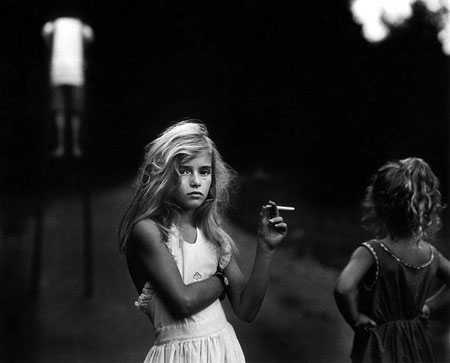
'Candy Cigarette', 1989

I tend to find photography exhibitions a bit dreary. There is a certain energy that surrounds handmade artwork - you can imagine the creator hard at work and their physical process. This is what photography lacks for me. However, The Photographers’ Gallery changed my mind last weekend.

I went along to the new Sally Mann exhibition with my dad and brother on Saturday. They are experts in the fields of art and photography, so I felt a little naive observing the work without such an analytical understanding.

Sally Mann is a successful American photographer, best known for black and white photos of her children and later landscapes of death and decay. In 2001 Mann was heralded as ‘America’s best photographer’ by Time Magazine. In 1949 Life magazine had similarly constructed the reputation of Jackson Pollock with such a headline. ‘The Family and the Land: Sally Mann’ is her first solo exhibition in the UK.

The first room displayed a collection of some of her more recent work. The images are ghostly and stare blankly at you as you wander round. Mann created these prints outside using a delicate technique called the ‘wet plate collodion process’, introduced in 1851. The technique is complicated and tactile and leaves Mann only five minutes to make the exposure.

My favourite works were the earlier family photographs displayed upstairs in the gallery. These controversially show three gorgeous children, often barely clothed. They are intimate and revealing portraits that offer an insight into her family life. ‘Candy Cigarette’ 1989, depicts her young daughter, pretending to smoke with a sweet cigarette. It is a beautifully captured moment, unsettling but stylish enough to appear in Vogue.

The final room, ‘What Remains’ is a collection of haunted landscapes some with discarded bodies in them. They are vague and eerie, and sometimes quite horrendous when looked at in detail. A startling contrast with the children’s portraits in the room before.

I loved this show, so much so that I even almost bought the insanely expensive catalogue.

Show continues until 19 September 2010. Check it out here.

Thursday, 10 June 2010

EXPOSED at the TATE MODERN


The EXPOSED timeline

EXPOSED- Voyeurism, Surveillance & the Camera is the photography exhibition currently on show at London's Tate Modern. We all enjoy watching others once in a while but do we know who is watching us?

You certainly get your money's worth at this show - with 14 large rooms to wander round you will need a good hour. EXPOSED explores the idea of the 'unseen photographer' and the interesting qualities of snapshots taken often without the subject's permission. The result is intriguing and sometimes shocking.

Amongst the lesser known artists you can spot some celebrated photographers including Guy Bourdin, Lee Miller, Helmut Newton and Man Ray.

I was particularly excited by the earlier rooms which explore the tactics of some undercover photographers and displayed the objects within which the cameras were concealed: shoes, walking sticks, even inside suit jackets. Do they still make these detective like items? If so where can I get my own?


A Photograph display in the EXPOSED shop

A few rooms on, in a rather more crowded space, are hung photos of celebrities. I began to think of a time when cameras weren't so accessible and photos of our favourite celebrities not so common and widespread. Teenagers would attend a concert to not only hear the music but to catch a glimpse of their idolised singer. Imagine the excitement of seeing a band for the first time after only having listened to them. Nowadays we expect to see every move every celebrity makes through photographic images, almost all curiosity is lost.

The final rooms of EXPOSED were not so appealing to me, and by the time I got to them I was exhausted from the rest of the exhibition. Photos and documentation of violent events are displayed. These are surprisingly harrowing to see and bring home the reality of those suffering. It is not an exhibition for children, but for those interested in photography and the way it insidiously records us whether we like it or not, it is worth a visit.